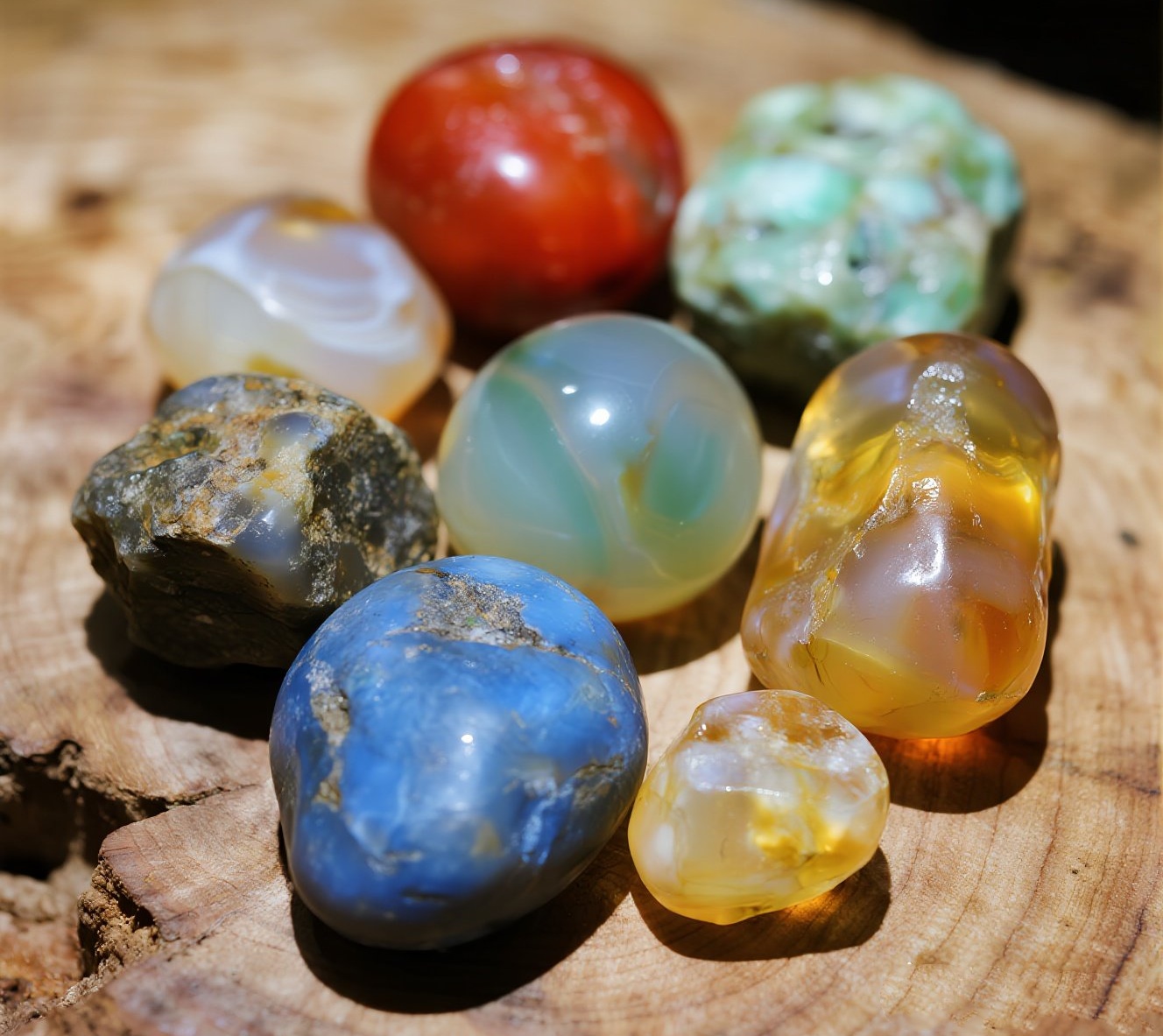
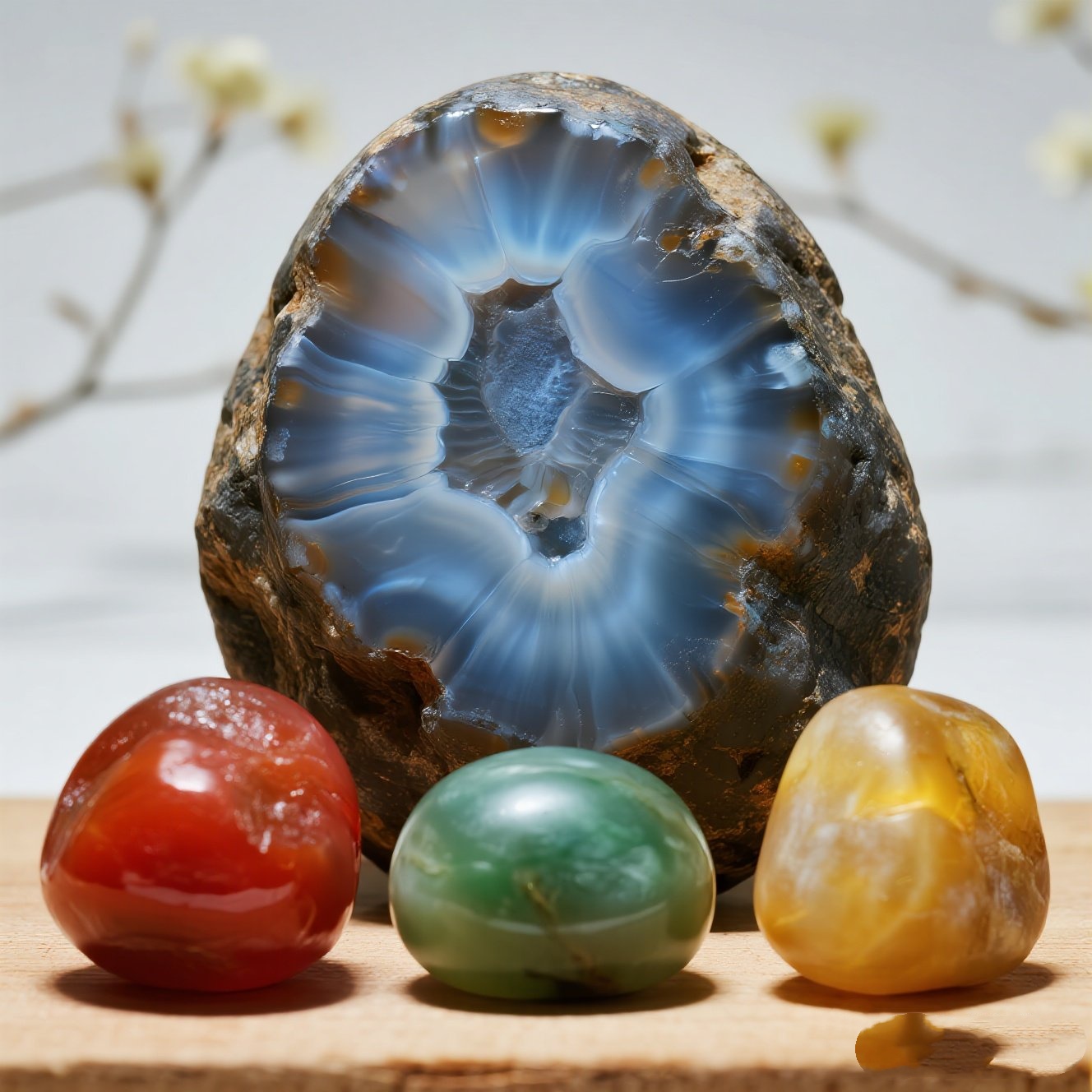
Crystal Story: Contemporary People's Spiritual Totems and Self-Healing Rituals
May 08,2025 | luckyzgy
In a cafe in a bustling city, you may have noticed such a scene: a young woman gently took out an amethyst pendant from her collar and unconsciously rubbed it in between conversations; in a subway car, a business person has a tiger eye bracelet wrapped around his wrist in addition to a famous watch; in a yoga studio, practitioners often place a few pieces of pink quartz or obsidian next to their mats. These seemingly casual details actually constitute a subtle cultural landscape in contemporary society - wearing crystals has evolved from an ancient witchcraft tradition to a psychological self-help ritual for modern people. Those mineral crystals that sparkle with natural light are telling the wearer's unspoken spiritual needs in silent language.
The historical roots of crystal culture are far deeper than we thought
The historical roots of crystal culture are far deeper than we think. The ancient Greeks believed that amethyst could prevent drunkenness, medieval Arab doctors used lapis lazuli to treat depression, and China's "Compendium of Materia Medica" recorded the effect of agate "improving eyesight and removing heat". In the era when science was not yet prosperous, humans instinctively projected their awe of nature onto these minerals with special colors and shapes. French anthropologist Levy-Bruhl called it the law of interpenetration in "primitive thinking" - people believe that by touching objects with certain characteristics, they can also get a certain quality., you can obtain the mysterious transmission of this quality. This mode of thinking has not disappeared with the advancement of science and technology, but has gained new forms of expression under the background of increasing pressure in contemporary society. Robert Bellah, an American sociologist, pointed out that the trend of "privatization of the mind" in the process of modernization has led people to turn to various non-institutionalized religious experiences, and crystal culture is a typical manifestation of this shift.
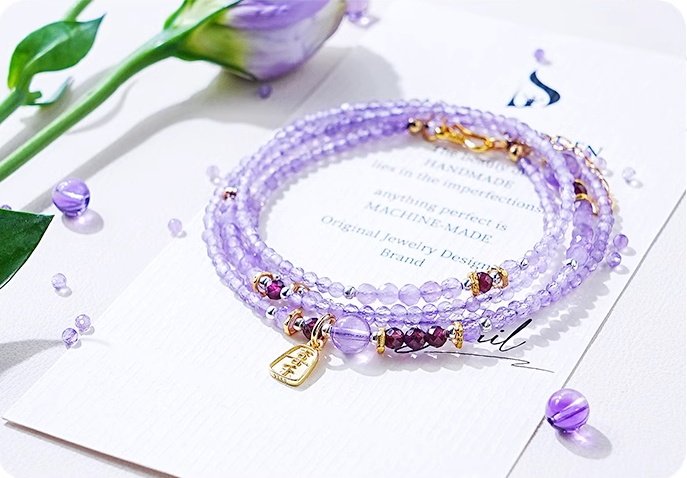
Walk into any crystal shop and you will be struck by the color-coded minerals: Rose Quartz represents love, Green Phantom symbolizes wealth, Tiger Eye enhances courage, and Amethyst promotes spirituality. This combination of color psychology and symbolism creates a complete symbol system. Canadian psychologist Jordan Peterson proposed in "Maps of Meaning" that humans build psychological defense mechanisms through symbol systems to cope with existential anxiety. When a new employee chooses to wear lapis lazuli, he is not only decorating his body,, but also a kind of self-definition - through this "projective identification", he associates himself with abstract qualities such as "communication ability" and "wisdom". British anthropologist Danny Miller found in his research on material culture that objects often become people's "externalized mind". Crystal, due to its unique natural formation and translucent texture, is particularly suitable as a carrier of this psychological projection.
The crystal wearer community presents interesting demographics
The community of crystal wearers presents interesting demographics. Market research shows that urban women aged 25-40 are the main consumers, but the proportion of male wearers is steadily increasing. Psychological counselor Zhang Li pointed out: "The proportion of people who wear crystals is significantly higher than the general population, and they usually have highly sensitive personality traits." These people often face specific modern dilemmas: knowledge workers are under invisible mental labor pressure, and the social media generation experiences emotional alienation brought about by virtual social interaction.Urban singles are facing a loss of sense of belonging after the collapse of the traditional family structure. For them, crystal is not only an ornament, but also a "transitional object" - just like the stuffed toys that children rely on, it provides stable psychological comfort in an uncertain world. German philosopher Benjamin once described collectibles as "secular enlightenment", and crystal collection just satisfies modern people's desire for tangible certainty.
From a neuroscientific perspective, the psychological effects of crystals may be partially explained. When people touch the smooth and cool surface of a crystal, skin receptors send specific signals to the brain; when people gaze at the light refraction inside the crystal, the visual cortex produces a unique activation pattern. Research at the University of California shows that objects with regular geometric shapes can induce alpha waves in the human brain.This brain wave is closely associated with a state of relaxation. Although there is no evidence that crystals have physical effects beyond the placebo effect, research by British psychologist Richard Wiseman has confirmed that the placebo effect itself can produce real physiological changes. When a speaker holds a carnelian, his increased confidence may be due to the adrenaline regulation caused by self-suggestion, which has nothing to do with the chemical composition of the mineral itself, but is directly related to the symbolic meaning given by culture.
Crystal Culture Goes Viral in the Social Media Age
Crystal culture has gained viral popularity in the social media era. There are more than 6 million posts under the tag #crystalhealing on Instagram, and the number of views of the topic "Crystal Wishes" on Xiaohongshu has exceeded 300 million. This spread presents typical "hyperreality" characteristics - a concept proposed by French philosopher Baudrillard, referring to a simulacrum that is more real than reality.Carefully posed crystal photos are often accompanied by scientific expressions such as "energy" and "frequency", forming a unique style that blends new-age spirituality with pseudo-scientific discourse. Japanese sociologist Masayuki Osawa calls this the phenomenon of "magical capitalism": in a highly rational modern society, mysticism has returned in the form of commercialization. When young people share crystal photos, they are not only showing their lifestyle, but also participating in a collective unconscious ritual - through likes and comments, they build a temporary spiritual community.
Behind the crystal craze, we can see the deep existential anxiety of contemporary people. French existentialist philosopher Camus once described the situation of modern people as "divorce from the world", and crystal culture just provides the fantasy of reconnection. In today's increasingly severe ecological crisis, these natural crystals from deep in the earth's crust have become the last material link between man and nature.German philosopher Heidegger's analysis of "being-there" may explain this obsession: when technology makes the world increasingly "disenchant", people are eager to rediscover the "aura" of the world. Crystal lovers may not really believe in the supernatural power of minerals, but they need the possibility of believing in it - as American religious scholar Joseph Campbell said: "Modern people no longer believe that myths are facts, but we need myths to experience psychological reality."
The boom in the crystal market may eventually ebb, but humanity’s need for systems of meaning will not disappear.
The prosperity of the crystal market may eventually ebb, but the human need for a system of meaning will not disappear. These minerals endowed with symbolic meanings are essentially the external projection of our inner images. When urban people hold crystals in their palms and silently recite affirmations in their morning rituals, they are not performing ancient witchcraft, but a modern version of self-programming.French sociologist Durkheim pointed out long ago that even in the most rational society, the sacred has never really disappeared, but has only shifted its form of expression. Crystal culture reminds us that in the digital age dominated by algorithms, the human mind still longs to touch real matter and to find its own warm metaphor in the cold universe. Those who wear crystals may face an existential truth more honestly than others - we need to create meaning for ourselves, even if this meaning is placed on a silent stone.
Comment